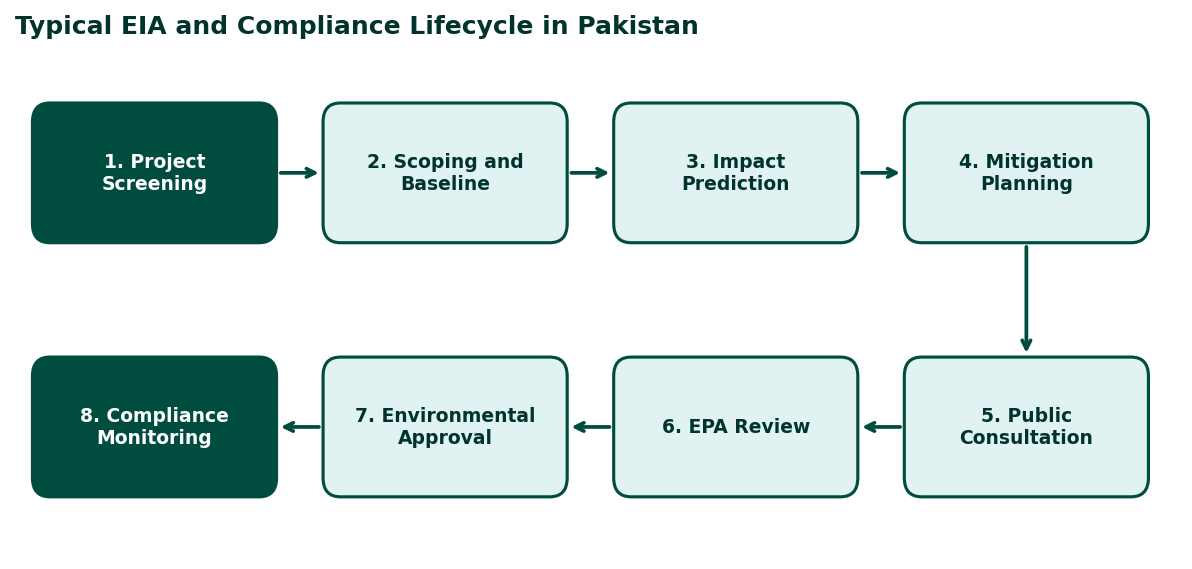
- EIA in Pakistan must shift from a mere pre-construction formality to a continuous, compliance-based lifecycle management process.
- Integrating climate resilience and adaptation is critical for infrastructure projects in the wake of severe climate vulnerabilities.
- Decentralized wastewater treatment technologies, such as LC-MBRs, offer significantly lower environmental and resource impacts compared to centralized systems.
- EPAs require institutional strengthening, technical capacity building, and meaningful public participation to bridge existing regulatory gaps.

The Regulatory Landscape of Environmental Impact Assessment in Pakistan
The legal foundation of environmental governance in Pakistan is anchored in the Pakistan Environmental Protection Act (PEPA) 1997 [5]. This landmark legislation, complemented by the Review of Initial Environmental Examination (IEE) and EIA Regulations 2000, establishes the mandatory requirement for project proponents to seek environmental consent from the relevant Environmental Protection Agency (EPA) before initiating any physical construction or development [5]. Under this framework, projects are categorized based on their potential ecological footprint, requiring either an Initial Environmental Examination (IEE) for projects with less severe impacts or a comprehensive Environmental Impact Assessment (EIA) for high-impact industrial, infrastructural, and commercial developments [5].
Following the devolution of environmental subjects to the provinces, provincial legislations have further defined these requirements. For instance, the Sindh Environmental Protection Act, 2014 provides the legal foundation for environmental protection, monitoring, inspections, and enforcement within the province of Sindh [2]. At the federal level, the regulatory framework continues to evolve, with the Pakistan Environmental Protection Agency overseeing draft rules and updated guidelines, such as the Initial Environmental Examination and Environmental Impact Assessment Regulations, 2022 [1].
For plant managers and industrial consultants, compliance requires strict adherence to the National Environmental Quality Standards (NEQS). These standards regulate municipal and liquid industrial effluents under S.R.O. 549 (I)/2000, S.R.O. 742 (I)/93, and S.R.O. 1023 (I)/95 [1]. Furthermore, ambient air quality, drinking water standards, and noise levels are governed by S.R.O. 1062(I)/2010, S.R.O. 1063(I)/2010, and S.R.O. 1064(I)/2010 [1], while motor vehicle exhaust and noise are regulated under S.R.O 72(KE)/2009 [1]. To ensure continuous compliance, the Self-Monitoring and Reporting by Industries Rules, 2001 (and its amended versions) mandate that industrial units monitor their emissions and submit regular reports to the EPA [1].
Understanding these overlapping regulations is critical for any new project. Navigating the complexities of Environmental Impact Assessments (IEE/EIA) requires a deep understanding of both federal and provincial laws to prevent costly delays and legal penalties, such as those enforced under the Compounding of Offences and Payment of Administrative Penalty Rules 2015 [1].
| Parameter / Impact Category | Decentralized LC-MBR Scenario | Centralized EA-ASP Scenario (49 km Route) |
|---|---|---|
| Wastewater Transportation Route | On-site decentralized treatment (0 km) | 49 km-long transportation route [6] |
| Human Health Impacts | 8% lower impacts [6] | Baseline / Higher impacts [6] |
| Resource Depletion Impacts | 60% lower impacts [6] | Baseline / Higher impacts [6] |
| Midpoint Performance | Outperformed centralized in 13 out of 15 categories [6] | Baseline performance [6] |
Beyond a Bureaucratic Hurdle: The Climate Crisis and Compliance-Based Management
Historically, many industrial owners and project developers in Pakistan have viewed the EIA process as a mere bureaucratic needle to be threaded before physical work can begin [5]. Once the environmental approval letter is issued, the environmental management plans are frequently shelved, and compliance is treated as a secondary concern [2, 5]. However, the rapidly escalating climate crisis in Pakistan has fundamentally changed the relationship between development and environmental protection [2].
The devastating floods of 2022, which affected millions of people, damaged critical infrastructure, and disrupted livelihoods across the country, highlighted the urgent need to integrate climate risks into development planning [2]. Although Pakistan’s contribution to global greenhouse gas emissions is comparatively low, its geographic exposure and socioeconomic challenges place it among the most vulnerable nations in the world [2]. In this high-risk environment, a project that appears economically viable today can quickly become an environmental and financial liability tomorrow if climate risks and ecological impacts are ignored [2].
Consequently, the role of the environmental impact assessment Pakistan must evolve from a static, pre-construction document into a continuous, lifecycle process [2]. True environmental responsibility does not end with the issuance of an approval letter [2]. Plant managers must transition from approval-based regulation to compliance-based environmental management, where the implementation of environmental management plans, continuous monitoring of emissions and waste, and the protection of local biodiversity are integrated into routine, daily decision-making [2]. A climate-resilient project is one that not only minimizes its ecological footprint but is also designed to continue functioning under future climate pressures, such as severe floods, heatwaves, droughts, and water shortages [2].
Structural Gaps and the Path to International Standards
Despite the robust legal framework established on paper, the practical implementation of the EIA regime in Pakistan faces significant structural and administrative challenges [5]. A critical analysis of high-stake infrastructure programs, such as the Lahore Orange Line Metro Train and energy setups within the China-Pakistan Economic Corridor (CPEC), reveals that EIAs are frequently hurried through, poorly scrutinized, or approved despite posing tangible ecological hazards [5]. This compromises public trust and raises serious questions about the politicization of environmental decision-making [5].
One of the primary barriers is the lack of technical skills, understaffing, and underfunding within both federal and provincial EPAs [5]. These regulatory bodies often lack the resources to thoroughly evaluate complex EIA reports or to enforce compliance during the operational phase of projects [5]. Furthermore, public consultation—a core pillar of effective environmental governance—remains largely representational in Pakistan, leaving affected local communities with no real voice in the consultative process [5].
These gaps are also evident in the energy sector. A comprehensive study investigating the structural limits of EIA guidelines for hydropower development in Pakistan revealed that while international donors like the Asian Development Bank and World Bank observe the implementation process, significant weaknesses persist in actual practice [3]. Specifically, more than 20% of respondent decision-makers disagreed that the current institutional framework complies with EIA guidelines, and 25% believed that the existing guidelines followed in Pakistan are not aligned with international standards and practices in actual practice [3]. This misalignment is particularly critical given that hydropower meets more than 16% of global electricity demand and generates 71% of all renewable energy [3].
To bridge these gaps, Pakistan can look to international frameworks. For example, India’s EIA Notification 2006 provides clearer project classification and more structured public hearings, while Canada’s Impact Assessment Act of 2019 institutionalizes independent federal regulators and explicitly integrates climate considerations into the assessment process [5]. For projects seeking international financing, compliance with the World Bank Operational Policies, the Equator Principles, and the International Finance Corporation (IFC) Performance Standards is essential [4].
Advanced Environmental Technologies and Life Cycle Assessments (LCA)
To meet the stringent requirements of a modern, climate-informed EIA, industrial facilities must adopt cleaner production technologies and advanced waste management systems [2]. Environmental compliance should not be viewed merely as a system of restrictions and penalties, but as an opportunity to drive innovation and resource efficiency [2].
In the field of wastewater management, conducting a Life Cycle Assessment (LCA) has emerged as an invaluable tool for evaluating the long-term environmental sustainability of different treatment options [6, 7]. A recent comparative study evaluated the environmental impacts of a decentralized low-cost membrane bioreactor (LC-MBR) serving a small community of 1300 persons in an arid region against a centralized extended aeration activated sludge process (EA-ASP) requiring a 49 km-long wastewater transportation route [6]. Using SimaPro ® 8.3.0.0, the ecoinvent 3.0 database, and the ReCiPe 16 midpoint methodology, the study demonstrated that the decentralized LC-MBR scenario outperformed the centralized option in 13 out of 15 selected midpoint categories [6].
The centralized EA-ASP scenario was heavily penalized by the high energy demand required for pumping wastewater over the 49 km route, whereas the decentralized LC-MBR resulted in 8% lower impacts on human health and 60% lower impacts on resource depletion [6]. This research highlights the environmental benefits of decentralized wastewater treatment system design for localized communities and industrial clusters in arid regions, offering a sustainable alternative that minimizes transportation costs and maximizes opportunities for treated effluent reuse [6].
Furthermore, modern EIAs must address emerging contaminants of concern, such as microplastics and nanoplastics, which act as vectors for chemical pollutants across aquatic and terrestrial ecosystems [7]. Advanced filtration technologies and wastewater treatment processes play a critical role in mitigating these emissions [7]. Similarly, in the pharmaceutical sector, managing active pharmaceutical ingredients in wastewater remains an ongoing challenge, as no current technologies achieve 100% removal of all pharmaceuticals [8]. To address this, advanced tertiary and post-treatment methods—such as combining fungal bioremediation with activated carbon—are being integrated into wastewater treatment plants to degrade and adsorb persistent compounds [8].
Critical GREEN's Engineering Solutions for Industrial Compliance
At Critical GREEN SMC (Pvt.) Ltd, founded in 2015, we specialize in bridging the gap between regulatory compliance and sustainable industrial operations. With our head office in Bani Gala, Islamabad, and regional offices in Lahore and Karachi, we provide comprehensive environmental engineering and consulting services across Pakistan.
Our core services include: * Environmental Impact Assessments (IEE/EIA): We prepare robust, climate-informed IEE and EIA reports that comply with federal and provincial regulations, as well as international donor standards such as the Asian Development Bank guidelines [4, 5]. * Wastewater Treatment System Design (ETP/STP): We design customized, high-efficiency effluent and sewage treatment plants [6]. * Industrial Effluent Treatment: We help industries meet NEQS limits for liquid discharges [1]. * Water Quality Laboratory Testing: We provide certified testing to monitor and report emissions accurately [1].
We leverage a wide range of advanced technologies to ensure your facility achieves continuous compliance, including: * Anaerobic Systems: UASB reactors and IC reactors for high-strength industrial organic waste. * Aerobic & Membrane Systems: Membrane Bioreactors (MBR), Sequential Batch Reactors (SBR), and Conventional Activated Sludge (CAS) systems. * Flotation & Physical Treatment: DAF/SAF flotation systems for oil, grease, and suspended solids removal. * Nature-Based Solutions: Constructed wetlands for low-cost, decentralized municipal and agricultural wastewater treatment.
Whether you operate in the Sugar & Distillery, Textile & Dyeing, Food & Beverage, Edible Oil, Pharmaceutical, Car Wash, Agriculture, Municipal, or Housing Societies sector, our team of experts is equipped to design, build, and monitor systems tailored to your specific operational needs.
Don't let environmental compliance become a bureaucratic bottleneck. Partner with Critical GREEN SMC (Pvt.) Ltd to secure your environmental approvals, minimize climate risks, and implement state-of-the-art treatment technologies. Please Contact Us today to discuss your project requirements with our lead consultants.
Frequently asked questions
What is the difference between an IEE and an EIA in Pakistan?
An Initial Environmental Examination (IEE) is conducted for projects with less adverse environmental impacts, while an Environmental Impact Assessment (EIA) is required for larger, high-impact industrial, infrastructural, and commercial developments prior to commencing physical work [5].
Which major laws govern environmental assessments in Pakistan?
The primary federal legislation is the Pakistan Environmental Protection Act (PEPA) 1997, complemented by the Review of IEE and EIA Regulations 2000 [5]. Provincially devolved laws, such as the Sindh Environmental Protection Act, 2014, govern provincial compliance [2].
How does climate change impact the EIA process in Pakistan?
Following disasters like the 2022 floods, EIAs must incorporate climate-related risks (such as floods, heatwaves, and water shortages) and greenhouse gas reduction opportunities to build long-term project resilience [2].
References
- Pakistan Environmental Protection Agency - environment.gov.pk. Accessed 30 September 2026.
- Beyond Approval: Why Environmental Impact Assessment Matters More in the Climate Crisis - DAWN.COM - www.dawn.com, 2026. Accessed 30 September 2026.
- Frontiers | Assessing the existing guidelines of environmental impact assessment and mitigation measures for future hydropower projects in Pakistan - www.frontiersin.org, 2023. Accessed 30 September 2026.
- Environmental and Social Impact Assessment – Project Procurement International - projectpi.pk. Accessed 30 September 2026.
- Environmental Impact Assessment (EIA) in Pakistan Law, Practice, and Gaps | ` - assajournal.com, 2025. Accessed 30 September 2026.
- Life Cycle Assessment of Low-Cost Membrane Bioreactor and Activated Sludge Systems for Decentralized Wastewater Treatment in Arid Regions - europepmc.org, 2026. Accessed 30 September 2026.
- Micro- and Nanoplastics in the Environment: Analytical Approaches, Environmental Fate, Life Cycle, and Remediation Strategies-A Scoping Review - europepmc.org, 2026. Accessed 30 September 2026.
- The Life Cycle Assessment of Filamentous Fungi in Pharmaceutical Bioremediation and Wastewater Management: A Critical Review - europepmc.org, 2026. Accessed 30 September 2026.
This article was researched and drafted by Critical GREEN's AI engineering assistant from the sources listed above and automatically fact-checked against them. Regulations and figures change - confirm current requirements with the relevant Environmental Protection Agency or talk to our engineers.