- UASB reactors can handle influent COD concentrations up to 15,000 mg/L in molasses-based systems.
- Multi-staged UASB configurations achieve methane conversion ratios as high as 97%.
- High organic loading rates (OLR) up to 45.0 g total COD (L d)-1 are achievable with two-stage systems.
- Phenol concentrations up to 500-750 mg/L are generally not inhibitory to the UASB process.
The Challenge of Molasses and Vinasse in Pakistan
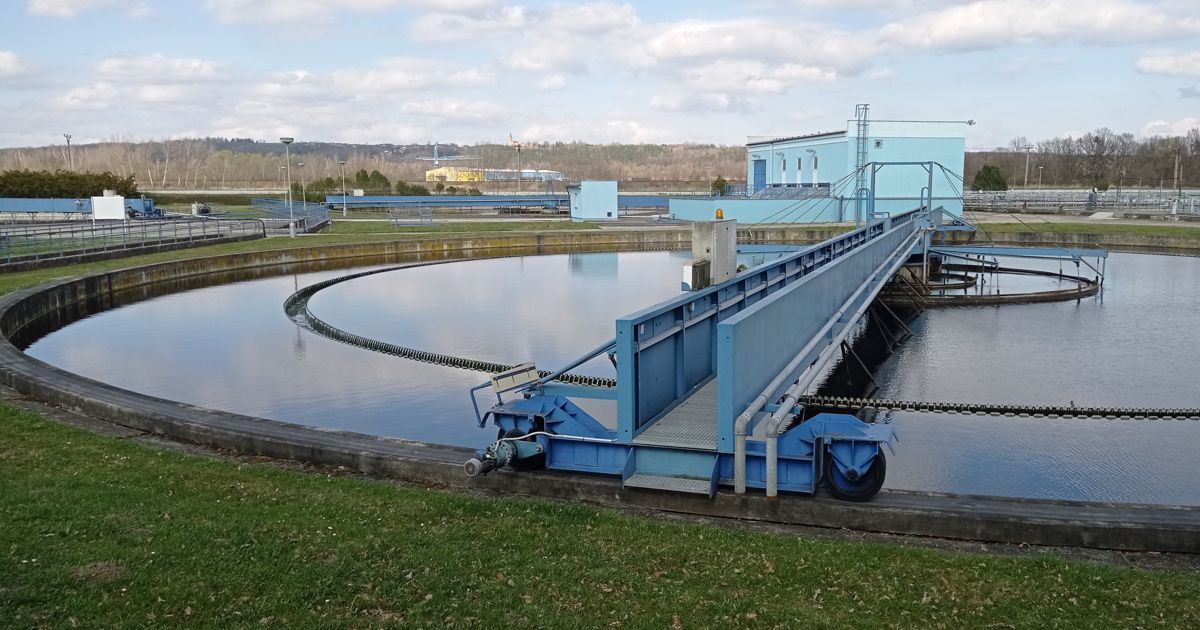
For the sugar and distillery sector in Pakistan, managing high-strength effluent like vinasse and molasses wastewater is a critical operational requirement. As of 11 November 2026, the industry continues to seek robust solutions for wastewater that often exceeds standard discharge limits. The UASB reactor has emerged as a primary technology due to its ability to process high organic loads while generating renewable energy in the form of biogas.
Research indicates that anaerobic digestion of products from the sugarcane industry, including vinasse and molasses supplemented with filter cake, is an effective option for biogas production [4]. However, the complexity of these streams—often containing phenols and high sulfate levels—requires precise engineering control. For instance, phenol concentrations in the range of 500-750 mg/L are generally not inhibitory to the UASB process, but concentrations exceeding 500 mg/L may require specific interventions. According to literature, these higher concentrations can be effectively treated with the acclimatization of inocula, recirculation of the treated effluent, and/or supplementing the system with co-substrates such as glucose, volatile fatty acids (VFA), and dilute molasses to maintain stability [1].
In the context of Pakistani mills, the seasonal nature of production means that reactors must be resilient to varying influent qualities. The integration of co-substrates like filter cake, which is readily available in sugar mills, has been shown to enhance the anaerobic digestion process in two-stage UASB systems [4]. This approach not only addresses the disposal of filter cake but also optimizes the volumetric methane production (VMP), which can reach up to 4.3 L CH4 (L d)-1 when operating in a series configuration [4]. Understanding the microbial dynamics and chemical thresholds is essential for plant managers aiming to maximize energy recovery while meeting environmental standards.
| Parameter | Value | Source |
|---|---|---|
| Maximum Influent COD | 15,000 mg/L | [2] |
| Max Organic Loading Rate (OLR) | 45.0 g total COD (L d)-1 | [4] |
| Methane Conversion Ratio | Up to 97% | [2] |
| Hydraulic Retention Time (Two-phase) | 25 h | [2] |
| Volumetric Methane Production | 4.3 L CH4 (L d)-1 | [4] |
| Non-inhibitory Phenol Range | 500-750 mg/L | [1] |
| Total Nitrogen Removal (DHS) | 27% | [2] |
Technical Performance and COD Removal Efficiencies
The efficiency of a molasses wastewater UASB system is heavily dependent on its configuration and the specific characteristics of the vinasse. In studies evaluating sugarcane molasses-based bio-ethanol wastewater, systems have been tested with influent concentrations reaching up to 15,000 mg chemical oxygen demand (COD)/L [2].
Multi-Stage vs. Conventional UASB Configurations
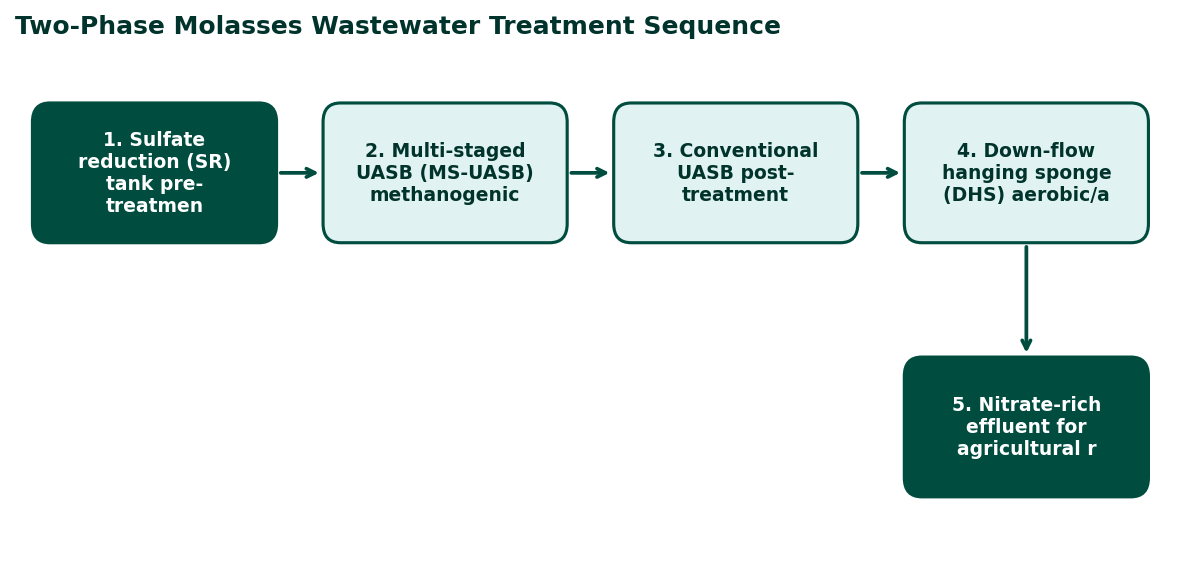
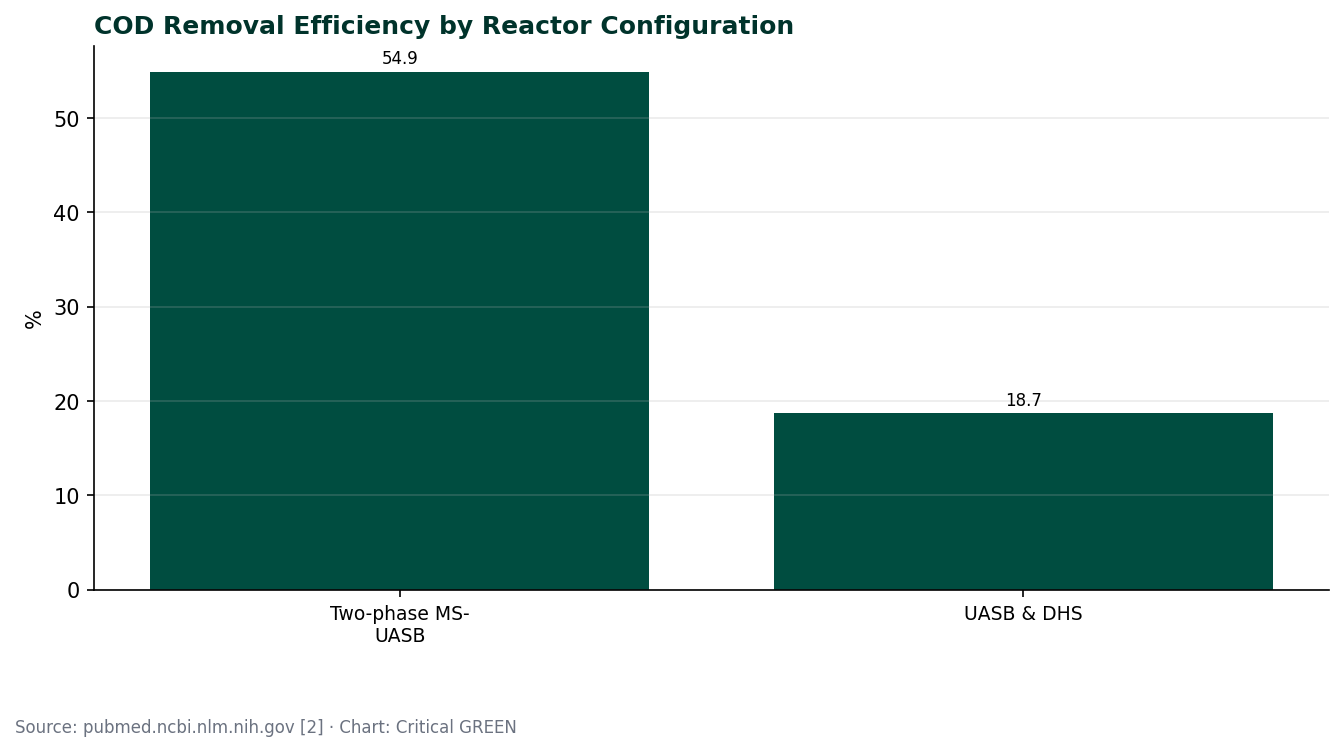
Advanced configurations, such as a two-phase treatment system comprising a sulfate reducing (SR) tank and a multi-staged up-flow anaerobic sludge blanket (MS-UASB), have shown significant advantages over single-stage units. Under ambient temperatures ranging from 24.6-29.6 °C, the COD removal efficiency of a two-phase MS-UASB was recorded at 54.9% [2]. This configuration is particularly effective for high-strength vinasse because the pre-treatment unit (the SR tank) handles the initial reduction of sulfates, which can otherwise lead to sulfide toxicity in the methanogenic phase.
In contrast, post-treatment units involving conventional UASB and down-flow hanging sponge (DHS) reactors showed a lower COD removal efficiency of 18.7% based on the influent COD [2]. The total hydraulic retention time (HRT) for such systems is typically kept at 25 hours for the two-phase pre-treatment system and 23 hours for the UASB and DHS post-treatment units [2]. For Pakistani distilleries, this implies that a multi-stage approach is necessary to achieve significant reductions in organic load before final discharge or secondary treatment.
Methane Conversion and Sulfide Management
One of the most critical findings for energy-conscious operators is the methane conversion ratio. Due to the effective removal of sulfide in the pre-treatment SR tank, the MS-UASB can achieve a methane conversion ratio of up to 97% [2]. This high conversion rate is essential for mills looking to offset energy costs through biogas recovery. Without the initial sulfate reduction phase, sulfide levels can inhibit the methanogens, leading to lower biogas quality and potential corrosion issues in the gas handling equipment. The MS-UASB's ability to maintain high conversion rates even at ambient temperatures (24.6-29.6 °C) makes it a viable option for the climatic conditions found in the Punjab and Sindh provinces [2].
Managing High Organic Loading Rates (OLR) and Shock Loads
Operational stability is a major concern for plant managers, especially during peak crushing seasons when the volume of molasses wastewater increases. Recent data highlights that two-stage UASB systems (designated as R1 and R2) can handle an organic loading rate (OLR) in the first stage (R1) of up to 45.0 g total COD (L d)-1 [4]. This represents a significant capacity for processing concentrated distillery waste.
Resilience and Recovery
When OLR values exceed these limits, shock loads can occur, potentially destabilizing the reactor. However, the robustness of these anaerobic systems is demonstrated by their ability to regain stability. Research shows that once the OLR is reduced following a shock load, the system can regain stability in terms of pH, alkalinity, and acidity values [4]. This resilience is a key factor in the selection of UASB technology for industrial effluent treatment in the sugar industry.
Microbial Dynamics in Stable Systems
The microbial population within the sludge granules plays a vital role in this stability. During the stable operation following a shock load, specific microbial genera have been found to prevail. Specifically, the genera Trichococcus and Methanosarcina were found to prevail over Bifidobacterium and Methanobacterium in the sludge of the UASB reactor (R1) [4]. Methanosarcina is known for its robustness and ability to utilize both acetate and hydrogen for methane production, which contributes to the reactor's ability to handle high OLR and recover from fluctuations. For Pakistani distilleries, maintaining a healthy sludge bed with these dominant genera is critical for long-term performance.
Phenolic Compounds and Inhibitory Thresholds
Molasses wastewater often contains phenolic compounds and cresols, which can be inhibitory to anaerobic processes if not managed correctly. A review of the UASB process indicates that phenol concentrations up to a range of 500-750 mg/L are generally not inhibitory [1]. This is a vital benchmark for Pakistani distilleries, where the concentration of these compounds can vary based on the sugarcane variety and processing methods.
Degradability of Phenols and Cresols
Not all phenolic compounds degrade at the same rate. Research has established a hierarchy of degradability: phenol is more degradable than p-cresol, which in turn is more degradable than m-cresol and o-cresol [1]. For wastewater containing phenol concentrations greater than 500 mg/L, effective treatment is still possible but requires specific operational strategies. These include the acclimatization of the inocula to the specific phenolic load and the use of effluent recirculation to dilute the influent concentration [1].
Furthermore, supplementing the reactor with co-substrates like glucose or dilute molasses can provide the necessary carbon source to maintain microbial activity while the population adapts to the phenolic stress [1]. This highlights the importance of water quality laboratory testing to monitor the exact composition of the influent and adjust the co-substrate dosing accordingly.
Bio-Hydrogen Potential and Nitrogen Management
Beyond methane, the UASB reactor is also being researched for anaerobic bio-hydrogen production from molasses wastewater. While many theoretical achievements have been made in this field, large-scale industrialization currently faces hurdles. The primary difficulties lie in the start-up and consistent operation of the UASB reactor for hydrogenic fermentation [3]. Strategies and suggestions for further research continue to be proposed to overcome these operational barriers, but for now, methane-focused digestion remains the industrial standard.
Nitrogen Removal and Fertilizer Value
For nitrogen management, post-treatment is often necessary to meet discharge standards. In systems utilizing a down-flow hanging sponge (DHS) reactor as a post-treatment unit, approximately 27% of total nitrogen (TN) can be removed [2]. The DHS reactor is unique because nitrification occurs at the outside portion of the sponge media while denitrification occurs at the inside [2].
This process results in an effluent where approximately 32% of the residual nitrogen (around 28 mgN/L) is in the form of nitrate [2]. This nitrate-rich effluent can serve as a superior nitrogen source for fertilizer applications in the agriculture sector, providing a circular economy benefit for sugar mills that often manage their own sugarcane fields [2]. The ability to transform waste into a nutrient-rich resource is a significant advantage of the UASB-DHS combination.
Conclusion and Implementation Strategies
The application of UASB technology in Pakistan's sugar and distillery sector offers a sustainable pathway for treating high-strength molasses wastewater. By utilizing multi-stage configurations, such as the MS-UASB, and co-digestion strategies involving filter cake and vinasse, mills can achieve high methane yields and stable COD removal. The data suggests that even under high organic loading rates of 45.0 g total COD (L d)-1, these systems remain robust and capable of recovery from shock loads [4].
Critical GREEN SMC (Pvt.) Ltd, founded in 2015, specializes in the design and optimization of wastewater treatment systems, including UASB and IC reactors. With our head office in Bani Gala, Islamabad, and regional offices in Lahore and Karachi, we provide comprehensive engineering services tailored to the specific needs of the sugar industry. Our expertise includes water quality laboratory testing to monitor phenol levels and microbial health, ensuring your system operates within the non-inhibitory range of 500-750 mg/L [1]. To optimize your distillery's effluent treatment plant and maximize biogas production, Contact Critical GREEN today.
Frequently asked questions
What is the maximum COD concentration a UASB can handle for molasses wastewater?
Systems have been successfully operated with influent concentrations reaching up to 15,000 mg COD/L [2].
Can UASB reactors produce hydrogen from molasses?
Yes, research exists on anaerobic bio-hydrogen production using UASB reactors from molasses wastewater, though large-scale industrialization currently faces start-up and operational difficulties [3].
What methane conversion efficiency can be expected?
With effective sulfide removal in a pre-treatment stage, a multi-staged UASB can achieve a methane conversion ratio of up to 97% [2].
How does the system respond to organic shock loads?
UASB systems are robust; stability in pH, alkalinity, and acidity can be recovered after a shock load by reducing the organic loading rate [4].
What is the inhibitory limit for phenol in a UASB?
Phenol concentrations up to 500-750 mg/L are generally not inhibitory to the UASB process [1].
References
- Treatment of phenol and cresols in upflow anaerobic sludge blanket (UASB) process: a review. - pubmed.ncbi.nlm.nih.gov, 2005. Accessed 11 November 2026.
- Sugarcane molasses-based bio-ethanol wastewater treatment by two-phase multi-staged up-flow anaerobic sludge blanket (UASB) combination with up-flow UASB and - pubmed.ncbi.nlm.nih.gov, 2014. Accessed 11 November 2026.
- The Research on Anaerobic Bio-Hydrogen Production Using UASB Reactor from Molasses Wastewater | Scientific.Net - doi.org, 2014. Accessed 11 November 2026.
- Co-Digestion of Sugarcane Biorefinery Byproducts in Upflow Anaerobic Sludge Blanket Reactors, in Series, with Application of High Organic Loading Rate - europepmc.org, 2026. Accessed 11 November 2026.
This article was researched and drafted by Critical GREEN's AI engineering assistant from the sources listed above and automatically fact-checked against them. Regulations and figures change - confirm current requirements with the relevant Environmental Protection Agency or talk to our engineers.